How many bands do you know that compose songs, powerful songs, that have lyrics along the lines of "Ôi orôrôi rôrôrôi rôrôrôi rôrôrôi rôrôrôi ohrorô poPÔ" and "Tatrrrepôtetretrepiecôã-é-é-ô-hã-hén-Hén"? I know only one, but I've heard more than one cover.
Focus is a Dutch band, and though you may think that this is some weird form of their language, it isn't. It is senseless, or at least so it is to the outsiders, to everyone else. Maybe it has some meaning to the band itself, or maybe they simply enjoy have a great laugh. I'd probably go for the second one! But either way, this song is great!
I am leaving you a cover version, by Helloween (One of my favorite bands), because I think it sounds better than the original one. However, if you really like classic rock, you should go ahead and find the one performed by Focus. Enjoy!
Tatrrrepôtetretrepiecôã-é-é-ô-hã-hén-Hén Ôi trégueregué-dôi detêro deguedô A tataro teguereguedaw Teguereguedêro dêdow Ô-Éhr-Ôhr-Êhr-Êhr-Áhr-Ó Hé Hã He How
It may seem odd to present the title of a novel, and a movie, as I am doing, while I talk about Metallica's famous song, "One". However, I need to give a bit of background to this song, which, as Cesc commented on an older post, is "definitely one of "those" songs which are way deeper than meets the ear."
On one hand, we have Metallica. One of the forefathers of Thrash Metal, a genre characterized by it's aggressive, angry tones. Those who are able to distinguish the different genres of Metal will, usually, imagine a crazy-eyed soldier, screaming at the top of his lungs, holding two huge machine guns shooting in every direction. It's ironic though, that most of these bands actually promote the opposite, and their sardonic lyrics are full of scorn for war and corruption.
On the other hand, we have the American novelist and screenwriter Dalton Trumbo. Trumbo's novel, Johnny Got His Gun, is a pacifist novel that opposed World War II (It was published in 1939). In the novel, Trumbo tells the story of Joe Bonham, a soldier who wakes up in a hospital after being hit by an artillery shell. Joe soon realizes that he lost his legs and arms, that he cannot hear, see, smell or speak. However, his mind is intact, and thus he becomes a prisoner of his own body.
This first stanza introduces Joe's situation, as he is suddenly conscious of darkness around him and pain. In the movie, you can hear Joe's voice saying "How can you tell what's a dream and what's real, when you can't even tell when you're awake and when you're asleep?" A main theme throughout Trumbo's novel is Joe's need to communicate, to escape his living prison.
At the beginning of the movie/novel, Joe believes that he cannot move his arms or legs, that he cannot see, talk or hear, because of the instruments used to heal him. It is not until the doctors begin to remove stitches from his shoulders and torso that he realizes he has lost most of his body.
In the story, every doctor in the hospital believe that Joe doesn't have a conscious brain anymore, and that Joe cannot feel anything, either pain or pleasure, joy or sadness. It is on this belief that he is left under such terrible condition, without any attempt to help him.
Joe tries to kill himself by holding his breath. However, he fails to do so because of a machine that pumps oxygen into his lungs. In his dreams, Joe recurrently speaks to Jesus, and asks him to help him out, to take the darkness away.
To be "back in the womb" is, for Joe, to re-live his life, to create himself again. Because he cannot interact at all with with exterior, Joe is forced to live in his memories. However, it is those memories that make Joe's situation more vivid, as it pumps the life he must feel. And yet, by this point Joe knows he cannot go forward, that there isn't much left for him.
Though the second line of the stanza may seem a bit odd, it adds up much of the novel. Joe wished that he was either killed, by cutting of the tubes that kept him alive, or that he was shown to the world. The latter being so everyone could see the horrors that war brought with itself, since at the time, Nationalism was still on the rise, and many saw war as a glorious matter (Remember, Johnny Got His Gun is an anti-war novel).
These lines depict the despair that Trumbo wanted to convey in the first place. Joe is one because there is nothing else for him. All is lost, and there isn't any chance to regain what he has lost.
The last stanza of the song simply shows how Joe is. It is easy to understand the whole song if you read the book, or you see the movie. The last line encompasses the idea that War leaves hell on Earth, as Joe is a could be anyone that goes to fight of a war.
You can actually watch Johnny Got His Gun on Youtube. It's quite a harsh movie, but I recommend it. There is also a new, 2008 version, but I have no idea where to get it.
The music video of the song has many images from the movie itself. Try to pay attention to what he says, as it correlates with the lyrics in many ways.
20 years ago, Megadeth released their most famous album, Rust in Peace. The album redefined what was beginning to be known as Thrash Metal. This month, Megadeth is doing a tour to celebrate the 20th anniversary, and to celebrate, David Ellefson, the longest member of Megadeth apart from Dave Mustaine, came back! And the best thing is, he will probably stay! It's an great moment for Megadeth fans, both long standing and new ones!
But that's not it. If you look at the promotional poster (Taken straight from the Megadeth website) you can see who they are touring with. Testament and Exodus, two Thrash Metal bands, that are awesome. However, they would deserve their own posts each, so I'll stop for now.
To commemorate this event, here are three videos. They are my three favorite songs from the album.
Tornado Of Souls (Live in Argentina):
I must admit, his voice really sounds HORRIBLE live. The good thing is, it proves they aren't fake
Hangar 18:
And you can hear the difference in his voice. Remember, that live concert was 17 years after the original was recorded.
Holy Wars... The Punishment Due (Live in Argentina):
And I leave you with yet another live version. Those stingy Youtubers disabled embedding for the studio versions. But you can always go yourself and watch them. Don't be so lazy!
I was looking through the blogs around the web, reading some very interesting ones, with exquisite opinions and thoughts on music. There were also some dull, boring ones, the kind no one will spend more than 10 seconds reading.But there was one that stood out among the mass. Audio Zealot, the writter, obviously knows what he/she is talking about, and has very interesting opinions.The latest post is about how the blog only speaks about music the person likes. It is written in a nice prose, which is comfortable to read, and somehow you end up feeling way smarter. Or maybe that's just me. Whatever it may be, I highly recomend reading the blog.
Let It Be is one the The Beatles most famous song, and one of the most meaningful in my opinion. In many cases, it describes what a person is going through, when they are in "times of trouble." There is a bit of controversy as to what the song is talking about, when we can assume that "Mary" is another name for Marijuana. If you think so, well, tell me, but now I am concerned with how the song appears to me.
According to Wikipedia (So, 60% chance it's wrong), Paul McCartney was inspired by this song because of a dream, where Mary, his mother, came to him and whispered "It will be alright, just let it be."
Of course, "Mother Mary" is an allusion to the Bible, and speaks of purity, faith and truth. Again, this will have a different meaning for different people, particularly Christians and non-Christians. For me, as a non-Christian, the allusion of Mother Mary means peace, and truth. Because, in the end, those who stick to that will end up winners, and those who don't, well, let's say they won't go far.
The song was released after McCartney announced his departure from The Beatles, and it clearly speaks of how even in the worst of circumstances, there will always be an answer, or someone to hold one to, thus "And when the night is cloudy, there is still a light, that shines on me, shine until tomorrow, let it be."
All in all, the song is a song of hope for those who are in their darkest hour, wheather it be heartbroken, betrayed, or even a mistake they made.
When I find myself in times of trouble, mother Mary comes to me,
speaking words of wisdom, let it be.
And in my hour of darkness she is standing right in front of me,
speaking words of wisdom, let it be.
Let it be, let it be, let it be, let it be.
Whisper words of wisdom, let it be.
And when the broken hearted people living in the world agree,
there will be an answer, let it be.
For though they may be parted there is still a chance that they will see,
there will be an answer. let it be.
Let it be, let it be, .....
And when the night is cloudy, there is still a light, that shines on me,
shine until tomorrow, let it be.
I wake up to the sound of music, mother Mary comes to me,
I was thinking of the songs I would analyse in the future, and I realized that most songs I have in mind are in the genre of Metal, something that many don't enjoy. I believe that the point of doing this is not just write about the songs I like, but the ones everyone can relate to. As an example, Symphony of Destruction or Where The Rain Grows might have very deep meanings, maybe they're very intelligent or well written. But only a few actually enjoy the music, the feeling of this genre. Which leads me to the title of this post. I don't think I can disclose the meaning of music, that would be a feat even for the greatest philosophers. But I have to acknowledge that lyrics are not everything, that the rythms and harmonies in each song are just as important. Because, though it might be great lyrics, the words were created with the music, and they should go along. And because they are to be together, one must listen to the music to find the core of meaning that a harmony of this kind conveys. So I want others to tell me what songs they like. What songs do you think have a special meaning, or go further than just the surface?
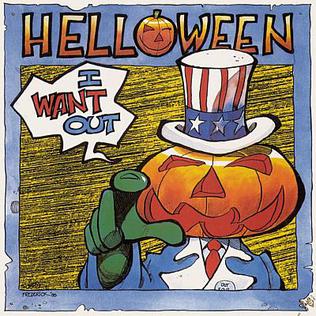
Band: Helloween. Song: I Want Out. Album: Keeper Of The Seven Keys, Part II.
Here is another post from Helloween. This band will be a recurring one in my posts, as they write lyrics that go deeper than just the surface, or write about things that I believe are important.
I Want Out is one of Helloween's most famous songs, as it speaks to many at the same time, while at the it shows a big step on the band's history, when Michael Kiske left the band. I Want Out is a song that portrays how society influences our decisions since the beginning. This song has many different connotations, ranging from political critique to simple, individual one.
From our lives' beginning on
We are pushed in little forms
No one asks us how we like to be
In school they teach you what to think
But everyone says different things
But they're all convinced that
They're the ones to see
The first stanza of the song si fairly straight forward. However, like I said before, it has different connotations. As it refers to social and political institutions, the song clearly refers to the way in which others decide what is good for us to learn, or how to do so. Political theories and parties, such as Socialists, Communists, Consevatives or any others, are generally based on principles that we learn since we're young. It follows that our later choices will be formed by our early teachings, thus, those that were given to us. The song also tells the story of Michael Kiske, the writer of the song. He believed that Helloween was moving to a very "heavy" sound, and wanted to change that, to a more light, lively upbeat band.
So they keep talking and they never stop
And at a certain point you give it up
So the only thing that's left to think is this
What these lines imply is that those who control what we learn will never stop, they will continue talking until we give up. Although the bridge has no deep, intricate meaning, without it the whole meaning of the song would we way more superficial.
I want out--to live my life alone
I want out--leave me be
I want out--to do things on my own
I want out--to live my life and to be free
This a cry to those who are under the influences discussed above. It is a cry for freedom, as they want to get out of that monotnous control. "I want out--To live my life and to be free" is one of the most important lines in the song. It's saying that if we leave the state in which we are, where we have no freedom nor life, we will achieve those things.
People tell me A and B
They tell me how I have to see
Things that I have seen already clear
So they push me then from side to side
They're pushing me from black to white
They're pushing 'till there's nothing more to hear
This stanza depicts a person who already knows what is good for them, what is bad, and what they want. Wheather it is freedom, a social reform, to leave the band, or even their choice of meal, what this line expresses is that no matter how clear we see life, there are always those who will keep pushing us "'till there's nothing more to hear." The second and third line of the stanza accounts for many of the revolutions that have happened in the past. As an example, the French Revolution (1789 - 1799) destroyed the monarchy that had been ruling for such a long time, because of the bad conditions the people had, or what they were told. The people revolted, but they ended up with Napoleon and an Empire, though what they wanted was a democracy.
But don't push me to the maximum
Shut your mouth and take it home
'Cause I decide the way things gonna be
The second bridge is, again, very important to the song, though not very deep. It is a direct challenge to the forces that control our life, and a way to proclaim our own freedom. At the same time, it is a slap in the face to Helloween, as Kiske has clearly decided about his future.
I want out--to live my life alone
I want out--leave me be
I want out--to do things on my own
I want out--to live my life and to be free
Like I've repeatedly mentioned before, the song has connotations that tell both the story of Kiske's departure, and socio-political themes. After Keeper of the Seven Keys, Part II went on sale, Kiske left the band and continued with his own project, Place Vendom. The chorus shows exactly what he thought, as his leaving Helloween was a very impopular move, and whatever he did next would not bring him such fame. Kiske did what he did because he wanted to do things on his own, to free his own conciousness.
There's a million ways to see the things in life
A million ways to be the fool
In the end of it, none of us is right
Sometimes we need to be alone
The last line of this stanza carries the whole weight of the song in it. To be alone, with out the influence or distraction of others is what Kiske wanted. Also, it serves social themes as it pushes away any form of opressive government. The first three lines, however, acknowledge that it all depends on one's point of view. When some may believe that on way is right, the others will destroy him, and the other way around too. In the end, no one has the right answer, as each serves individual purposes.
No no no, leave me alone
I want out--to live my life alone
I want out--leave me be
I want out--to do things on my own
I want out--to live my life and to be free
So, in the same way that there are million ways to look at things, there are a million interpretations of this song. Perhaps you will read this, and think I am horribly wrong, and I misread the whole thing. Perhaps you agree with me. But, if you have an opinion, let me know!